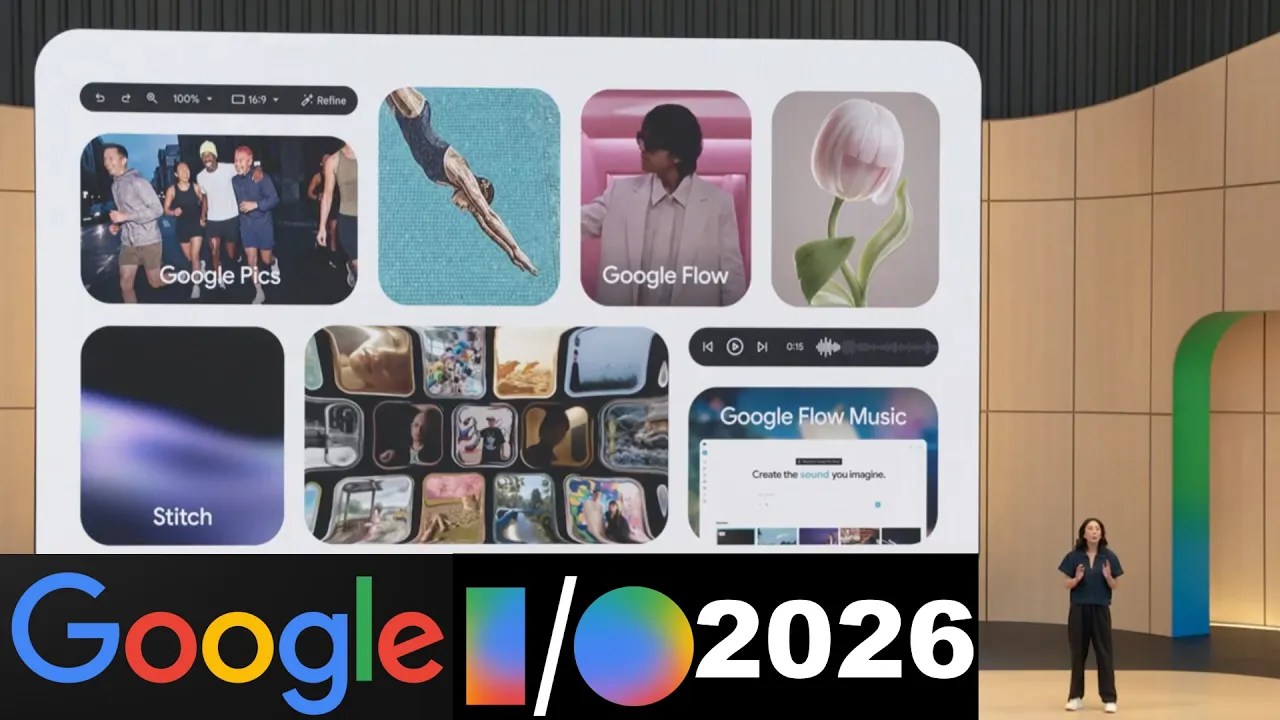
Google introduced a new wave of AI-powered creative tools at Google I/O 2026, focused on helping creators, businesses, designers, and developers turn ideas into finished products faster than ever before.
The company showcased major updates across Google Workspace, UI design, video creation, and AI music generation — all powered by Gemini and Google’s latest generative AI models.
“The Real Breakthrough Isn’t the Technology”
Opening the presentation, Google emphasized that AI is not replacing creativity — it is accelerating it.
According to Google, the goal of its new tools is to reduce the gap between having an idea and actually creating something meaningful.
The company introduced three major products:
- Google Pix
- Stitch updates
- New Google Flow AI features
Together, they represent Google’s expanding push into AI-powered creative workflows.
Google Pix: AI Image Creation and Editing Tool
Google officially announced Google Pix, a new image creation and editing platform coming to Google Workspace.
Pix is designed to help users quickly create visual content such as:
- Party flyers
- Social graphics
- Marketing visuals
- Infographics
- Presentations
AI-Powered Editing Features
Google demonstrated how Pix understands objects and layouts inside an image, allowing users to:
- Remove objects with a click
- Resize elements intelligently
- Edit and reposition content
- Add and translate text instantly
The platform uses AI to understand how elements work together inside a composition, making advanced editing much simpler for non-designers.
Google also confirmed that all AI-generated outputs from Pix will include SynthID watermarking for transparency and authenticity.
Pix is expected to roll out later this summer.
Stitch: AI Website and UI Design Platform
Google also announced major updates to Stitch, its AI-powered UI and website creation tool.
According to Google, Stitch has already been used to generate more than 100 million UI screens over the past year.
Design with Prompts and Voice Commands
The updated Stitch platform allows users to:
- Generate website layouts from a single prompt
- Refine designs in real time
- Use voice instructions for editing
- Export directly to code
- Launch websites quickly
In the demo, Google showed how a small pizza business with no design experience could generate a functional website interface simply by describing what they wanted.
Users could then continue refining the design naturally by saying commands like:
- “Make the header text larger”
- “Highlight more pizza options”
The layout updated instantly based on the prompts.
Google says the new Stitch updates are rolling out globally starting today.
Google Flow Gets Massive AI Upgrades
Google also showcased major improvements to Google Flow, the company’s AI-powered creative studio for images, films, and music.
Google revealed that millions of users are already using Flow for AI-assisted content creation.
Gemini Omni: Advanced Video Transformation
One of the biggest announcements was Gemini Omni.
Gemini Omni allows creators to:
- Transform environments
- Add visual effects
- Insert characters
- Preserve original performances
- Apply style references to footage
Google demonstrated how raw video footage could be transformed into entirely new cinematic scenes while keeping the actor’s original movement and pacing intact.
New AI Agent for Multi-Step Creative Workflows
Google also introduced a new AI agent inside Flow capable of handling multiple actions simultaneously.
Previously, Flow processed one prompt at a time. Now, the agent can:
- Analyze scenes
- Generate multiple camera angles
- Create several video variations at once
- Perform large-scale contextual edits
In one example, the AI transformed daytime desert footage into nighttime scenes while automatically adjusting:
- Lighting
- Sky appearance
- Vehicle headlights
- Dust illumination
Google described the feature as “a true collaborator” for creators.
Flow Tools: Build Custom AI Creative Utilities
Another new feature called Flow Tools allows users to create their own AI-powered creative tools directly inside Flow.
Users can build and remix custom utilities for:
- Video effects
- Hand-drawn animation
- Text layering
- Visual styling
- Experimental workflows
Google referred to this as “vibe coding” for creative tools.
Google Flow Music: AI-Powered Music Creation
Google also introduced Google Flow Music.
The feature helps musicians turn rough ideas into polished musical concepts using AI.
In the demo:
- A teammate uploaded a simple piano recording
- The system generated an R&B-inspired arrangement
- AI-created female vocals were added automatically
Google explained that the generated track served as a creative reference for the artist’s band rather than a final replacement for musicians.
AI as a Creative Partner
Throughout the presentation, Google repeatedly emphasized collaboration between humans and AI.
Rather than positioning AI as a replacement for artists, designers, or musicians, the company framed these tools as creative accelerators designed to help people experiment, prototype, and iterate faster.
From small business owners building websites to musicians developing song ideas, Google says the future of AI is about expanding creative possibilities.
All major updates to Google Flow and Google Flow Music are available starting today, while Google Pix launches later this summer.