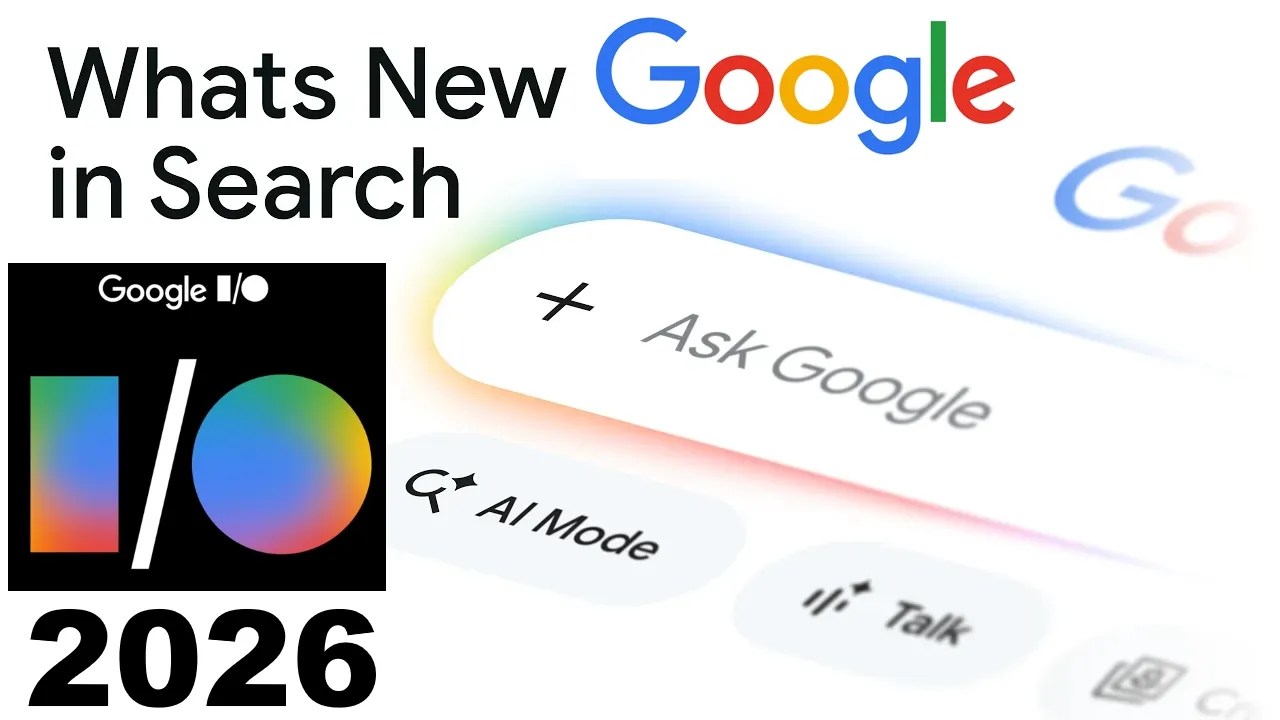
Google unveiled a major transformation of Search at Google I/O 2026, introducing a new AI-first search experience powered by Gemini models, autonomous search agents, and real-time generative UI that can build interactive tools and dashboards directly from user queries.
The company described this as the next chapter of Search — moving from answering questions to actively completing tasks, building experiences, and assisting users continuously.
AI Mode Reaches 1 Billion Monthly Users
Google announced that its AI-powered search experience, known as Google Search AI Mode, now serves over 1 billion monthly users.
Search queries are also growing rapidly, with AI Mode usage more than doubling every quarter since launch.
According to Google, users are increasingly asking complex, conversational questions instead of simple keyword searches, such as full itinerary planning or multi-constraint decision-making queries.
A New Intelligent Search Box
Google introduced a completely redesigned search box that adapts to user intent.
Key Features:
- Expanding input field that responds to curiosity
- AI-powered query suggestions beyond autocomplete
- Multimodal input (text, images, files, videos)
- Context-aware question refinement
Google says this is the biggest redesign of the search box in over 25 years.
The feature is rolling out globally across desktop and mobile.
Seamless AI Search Experience
Google is merging traditional search results with AI Mode into a unified experience.
Users can now:
- Start in standard search results
- Continue conversations in AI Mode
- Maintain context across interactions
- Access more relevant links and sources as queries deepen
This creates a continuous AI-driven search flow instead of separate search modes.
Search Agents: AI That Works in the Background
A major announcement was the introduction of autonomous search agents inside Google Search.
These agents can:
- Monitor topics continuously
- Track real-time updates
- Trigger alerts based on user-defined conditions
- Execute multi-step research tasks
Google demonstrated examples including:
- Stock monitoring for biotech companies
- Apartment hunting across multiple platforms
- Sneaker drop tracking for collectors
These agents work alongside Gemini Spark to perform complex tasks across systems.
Agentic Coding and Generative UI
Google also introduced “agentic coding” inside Search, powered by Gemini 3.5 Flash and its anti-gravity execution environment.
Search can now:
- Write and execute code in real time
- Generate custom UI components
- Build interactive widgets and dashboards
- Create full mini-apps based on user questions
Example Demonstrations
Google showcased interactive educational tools, including:
- Black hole simulations
- Gravitational wave visualizers
- Adjustable astrophysics models
Users can manipulate variables like mass and orbital distance to explore scientific concepts dynamically.
Personalized “Weekend Planner” Example
In a live demo, Search generated a fully interactive weekend planning tool that:
- Integrated calendar events
- Used personal preferences (family, interests, schedule)
- Suggested activities and restaurants
- Adjusted layouts dynamically based on user input
- Allowed real-time editing and sharing
The system also synced changes directly to Google Calendar and other services.
Agentic Commerce: A New Shopping System
Google introduced a major shift toward AI-powered shopping using its shopping graph of over 60 billion listings.
The system is built on three core components:
1. Universal Commerce Protocol (UCP)
A new open standard that enables interoperability across retailers, platforms, and services. It supports:
- Product discovery
- Checkout
- Shipping tracking
Major partners include Amazon, Meta, Microsoft, Salesforce, and Stripe.
2. Agent Payments Protocol (AP2)
A secure framework allowing AI agents to make purchases under strict user-defined controls.
Key features:
- Spending limits and brand restrictions
- Transparent transaction logs
- Privacy-preserving verification
- Secure digital payment mandates
3. Universal Cart
A smart shopping cart that works across Google products such as Search, YouTube, and Gmail.
It can:
- Track price drops
- Suggest better product alternatives
- Detect compatibility issues (e.g., PC parts)
- Find hidden discounts
- Sync with Google Wallet and Google Pay
Smarter Shopping with AI Reasoning
Google demonstrated how the universal cart can:
- Prevent incompatible product purchases
- Recommend better alternatives
- Optimize checkout across multiple retailers
- Automatically apply promotions and savings
The system is rolling out in the US across Search and the Gemini app, with expansion to YouTube and Gmail planned.
A New Era of AI Search
Google positioned this transformation as a shift from search as a tool to search as an active assistant.
Search will now:
- Answer questions
- Build tools
- Execute tasks
- Monitor information continuously
- Complete transactions on behalf of users
The company says this brings together:
- Information retrieval
- AI reasoning
- Agentic automation
- Commerce integration
All into a single unified system.
Google concluded that the future of Search is simple: you just ask — and everything else is handled for you.